One system for the whole visit
HyperCRM is practice management software for clinics that run on appointments and keep clinical records. The booking, the intake form, the note, the files and the invoice live in one place instead of three systems you reconcile by hand.
Watch: What HyperCRM is
The calendar, the record and the billing, as one system.
The shape of a visit
Book the appointment
A patient books online, or is booked in against a chair, room or practitioner, with availability worked out from your working hours.
Complete the intake form
They fill in an intake form from a link that expires, rather than a paper form that has to be typed up later.
Write the clinical note
The clinician writes a note that keeps its full revision history, so an entry can always be traced to a person and a time.
Attach files and imaging
Files and imaging attach straight to the record, so nothing about the visit lives in a separate folder or drive.
Invoice the visit
The visit is invoiced from a service catalogue, with tax handled and a receipt ready to print.
The whole visit, in one place
The appointment
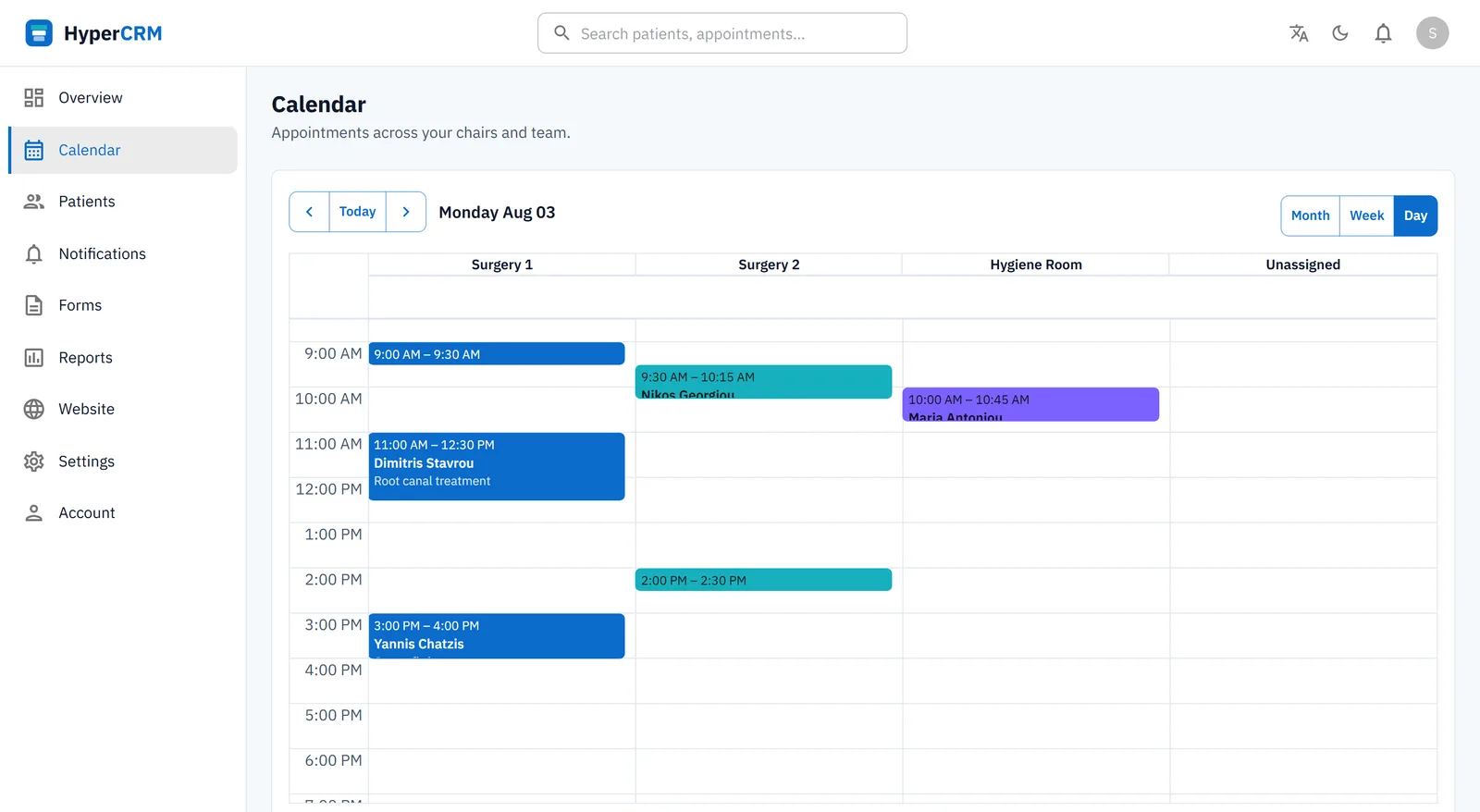
Online booking, a calendar that books against chairs, rooms and practitioners, availability from your working hours, and automatic reminders.
The record
Clinical notes with full revision history, intake forms with signature capture, and per-patient files including imaging and 3D scans.
The invoice
Charges and receipts against a service catalogue, tax configuration, printable invoices, and CSV export of everything you hold.
Built for how a small practice actually works
Most practice software is either an expensive suite designed for hospitals or a booking tool that stops at the appointment. Neither fits a clinic with an owner, a handful of staff and no IT department — so those clinics end up running a calendar, a spreadsheet and a filing cabinet, and reconciling them by hand.
HyperCRM covers the visit end to end. A patient books online or is booked in against a chair, room or practitioner. They fill in an intake form from a link that expires. The clinician writes a note that keeps its full revision history. Files and imaging attach to the record. The visit is invoiced from a service catalogue. Everything is one system, and every change is logged.
It adapts to your field
Every practice runs the same system: records, calendar, billing, forms, files and reporting. What changes is the vocabulary on screen — a dental practice sees patients and chairs, a physiotherapy clinic sees patients and treatment rooms, an aesthetic clinic sees clients instead of patients — and dental practices start from a service catalogue that is already filled in rather than a blank price list.
That is how HyperCRM serves several kinds of practice without becoming generic, and why a clinic that treats more than one kind of patient does not need two products.
Ask for the work, or connect your own AI
There is a chat bubble in the corner of every screen. Ask it to find a patient, move an appointment, add a charge or explain how something works, and it does the work in the app — showing you what it is about to change before it changes it. It runs as you, with your own permissions, and it acts when you ask it to and not otherwise. There is no chatbot facing your patients, nothing writes to a record on its own, and nothing is scored or predicted.
If you already work with an AI assistant, connect it directly. HyperCRM runs a Model Context Protocol server — the same 57 tools, authorised with OAuth 2.1 and scoped to your practice alone — so a client like Claude Code or Claude Desktop can work with your practice without anything being copied out of it. More about the assistant.
Priced in public, built to be trusted with records
Every price is on the pricing page — no quote, no sales call, no per-seat surprise for reception and admin. Records are protected by passkey sign-in, role-based access and an audit log of every change; the security page sets out exactly how, without the usual vagueness.
Common questions
HyperCRM suits appointment-based practices that keep clinical records: dental, medical, surgical, physiotherapy and aesthetic clinics. They all run the same system, using the words their own field uses — and dental practices additionally start from a service catalogue that is already filled in.
HyperCRM is paid software. Every practice starts with a 30-day free trial of the full Complete plan, with no card required. After that, plans start at €19 and €29 a month excluding VAT, banded by how many practitioners you have. Every price is printed on the pricing page rather than quoted on a call.
Patient records are encrypted in transit and at rest, files are stored privately and served through short-lived signed links, and every change is written to an audit log. Staff accounts sign in with passkeys rather than shared passwords.
Only what you already have, and only when you ask. The assistant runs as you, with your own role's permissions, and shows you exactly what it is about to change before it changes it. It never talks to your patients, never writes to a record on its own, and does not predict or score anything. If you connect your own AI through the MCP server, the same limits apply to it.
Yes. Every list in HyperCRM exports to CSV from the app, and your files can be downloaded at any time. Your practice data belongs to you, and there is no export fee or waiting period — on either plan, during the trial, and after you cancel.
See it with your own practice
Set it up with one week of your own appointments and see whether it fits. No card, nothing to cancel.
Start the free trial